


More for you

About the service
Colorado Guardianship Planning: Choosing a Caregiver and a Backup
Protect Them
Beyond
This Lifetime

Guardianship can mean planning for a child’s future care or asking a court to give someone authority now. Start by naming the decision you need made. Who could care for your child if you couldn’t? Does an adult need help with a care decision, or does someone need authority over money or property?
On this page
- Which decision are you facing?
- Plan ahead for a child
- Choose a caregiver and a backup
- If you need authority now
- Care decisions versus money decisions
- What to bring to a planning meeting
Which decision are you facing?
These paths may overlap, but they call for different records and next steps. The chart is a starting point. The links below take you to the Colorado Judicial Branch for court procedures.
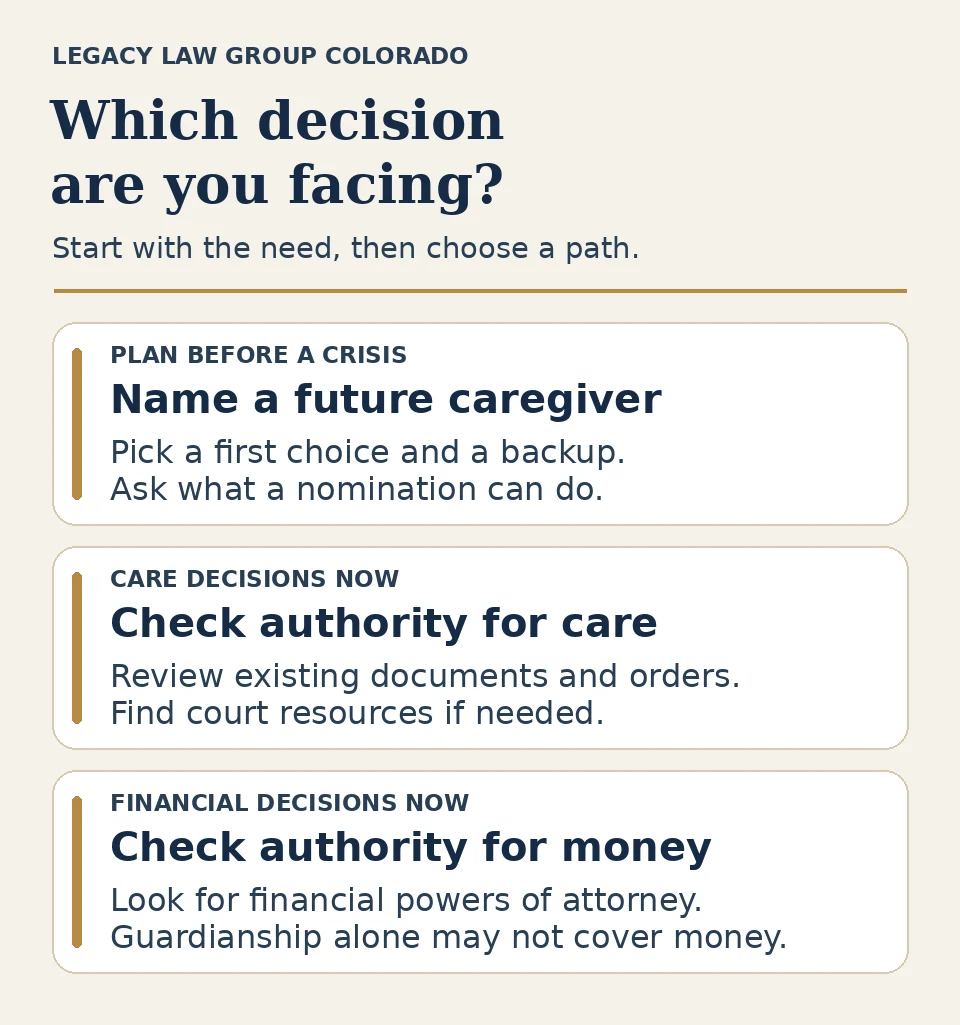
- Planning ahead for a child? Choose a primary caregiver and a backup. Talk through how to document your choice and what to do if someone needs to help before a longer-term arrangement is in place.
- Need authority for care now? Find any signed documents and current court orders. Then check the court guidance for the person’s age and situation.
- Need authority for money now? Check financial powers of attorney, trust documents and court orders. A care role does not automatically give someone authority over a bank account or other property.
Plan ahead for a child
Colorado law provides a way for a parent or guardian to name a guardian for a child in a will or another signed writing. A name on paper does not automatically give the person authority today. A surviving parent’s rights and existing orders can matter. When this type of appointment takes effect, the person named must file an acceptance before acting as guardian and give the required notices. See C.R.S. §§ 15-14-202 and 15-14-203 and the Colorado court guidance for a person named in a will.
For a planned, temporary need, a parent may be able to delegate certain powers by a separate power of attorney under C.R.S. § 15-14-105. A temporary delegation and naming a future guardian do different jobs. Ask what fits your family’s plans, timing and any existing orders.
Watch: Legacy Law Group Colorado explains what parents should know about guardianship and why families should make a plan before they need it.
Choose a caregiver and a backup
There may not be a perfect choice. A good place to start is with two people you trust and an honest conversation about what each person could take on.
- Choose a primary and backup caregiver. Discuss where the children would live, school routines, siblings, health needs and how a move might affect them.
- Talk about the first day. Who could get to school or home quickly? Who would call the longer-term caregiver? Keep a current list of contacts, allergies and medications, and check any school pickup rules.
- Plan separately for money. Ask who should manage the resources set aside for the children. That person may be different from the day-to-day caregiver.
- Tell the right people where to look. Keep signed records in a secure place and make sure your chosen people know who to call. Review the choices after a move, family change or if someone can no longer serve.

If you need authority now
If someone needs authority to make a decision now, start with any existing orders and planning documents. A court matter is separate from planning ahead. The Colorado Judicial Branch has information on becoming a guardian for a minor, becoming a guardian for an adult and becoming a conservator for an adult. An attorney who handles those court matters can help you decide which path applies. Do not wait for an estate planning appointment if immediate authority or safety is at issue.
Care decisions versus money decisions
Guardianship generally concerns care and personal decisions. Conservatorship generally concerns money and property. The actual authority depends on the court order and other valid documents. A school pickup authorization, a medical power of attorney and a financial power of attorney are also different tools. If an adult can still make decisions and sign documents, ask whether powers of attorney or another less restrictive approach might fit.
Example: A parent is suddenly hospitalized and a grandparent can pick up the children. School permission to do that does not necessarily authorize other decisions or let the grandparent manage the parent’s money. A practical plan identifies who can handle each job, what documents apply and where to find them.
What to bring to a planning meeting
Bring the names you’re considering, your children’s ages and a list of practical needs. If you have signed estate planning documents, caregiver authorizations or relevant orders, bring those too. You can start with a few notes and questions.
Read our estate planning guide for parents of minor children or ask Legacy about planning ahead. We can talk about how caregiver choices fit into an estate plan and what to decide next.
Colorado Guardianship Questions
Can I name a guardian for my child in my will?
Colorado law provides a way to name a guardian in a will or another signed writing. Existing orders and a surviving parent’s rights can matter. The person named must file an acceptance before acting as guardian under this kind of appointment.
Is a short-term caregiver the same as a guardian?
No. Temporary authority for certain decisions and a longer-term guardianship have different purposes and requirements. Ask what the caregiver needs to be able to do and when.
Does a guardian automatically manage money?
Not necessarily. Check the court order and any other valid authority. A conservatorship addresses financial matters, while guardianship generally addresses personal care.
What if my chosen person moves or can’t serve?
Talk with your first choice and backup. Check the documents again after major changes, including moves, changes in a caregiver’s circumstances or changes in your family.
Contact us


Make a Plan for the People Who Depend on You
Planning ahead can begin with a simple question: Who would you call first, and who could step in if that person couldn’t? Bring your ideas and any existing documents.
Request a planning conversation with Legacy Law Group Colorado.
Contact us
"Peace of mind for you and those left behind."
anastasia faingerg, founder and principal attorney

Getting started
Get Started with estate planning in denver
Step 1
SCHEDULE An Estate PLANNING SESSION
Step 2
COMPLETE AN ESTATE PLANNING WORKSHEET
Step 3
ATTEND An Estate PLANNING SESSION


Experienced professionals
Our team comprises seasoned attorneys with extensive legal expertise and knowledge.

Client focused
We prioritize our clients' needs, providing personalized and effective estate planning solutions.

Proven success
Our firm has a track record of giving our clients the best possible estate planning solutions for their specific needs.

Comprehensive services
We offer a wide range of estate planning services for any type of situation you may find yourself in.


